


Installing tile can greatly enhance the look and feel of any space, from kitchens and bathrooms to patios and pools.
However, perfectly cutting tile requires specialized tools. A wet tile saw is an essential piece of equipment for any tile installation project, enabling you to make accurate straight cuts, miter cuts, curves, and holes in tile materials like ceramic, porcelain, stone, and glass.
This buying guide provides an in-depth look at selecting the right wet tile saw for your needs.
Types of Wet Tile Saws
Wet tile saws come in a variety of types including benchtop, stand, and sliding table saws. Benchtop tile saws are the most compact and affordable option, providing portability for small jobs.
Stand tile saws feature the saw mechanism mounted on a floor stand for added cutting capacity. Sliding table saws allow the operator to remain stationary as the saw slides underneath the tile.
They offer the highest precision and capacities for industrial use. Selecting the right type depends on your cutting needs, workspace, and budget.
There are several types of wet tile saws to consider:
Benchtop Tile Saws
The most common and affordable option, benchtop wet tile saws sit on a table or workbench. They typically feature a sliding table that moves the tile past a compact circular saw blade mounted below the water reservoir.
Benchtop saws range from basic models for DIYers to more powerful saws with extension tables for pros. They provide portability and take up minimal space.
Stand Tile Saws
Stand tile saws are floor units with the saw mechanism mounted on a metal stand. The tile slides onto a larger stationary table. Stand saws offer more power and larger cutting capacities than benchtop models. Their floor footprint makes them less portable but provides more stability.
Sliding Table Tile Saws
Sliding table saws allow the operator to remain stationary as the saw mechanism moves. The tile is secured to a sliding table that glides underneath a suspended saw. This provides control when making long cuts. Sliding table saws are high-capacity professional models.
Overhead Tile Saws
Overhead tile saws feature a blade hanging from an overhead arm. The tile remains fixed while the blade lowers down. This creates a more ergonomic workflow for repetitive cuts. Overhead saws excel at volume jobs.
Points to Consider When Buying
Key factors to consider when selecting a wet tile saw include blade size, motor power, water reservoir capacity, cutting depth, precision adjustments, portability, and price.
Larger blades cut thicker tiles, while more powerful motors handle dense materials. Adequate water reservoirs reduce refilling. Maximum cutting depth should exceed your thickest tiles.
Adjustable fences, miter gauges, and inclination control precision. Portability affects mobility. Prices range from affordable home models to heavy-duty professional saws. Evaluate these factors against your projects to choose the right saw.
Key factors to evaluate when selecting a wet tile saw include:
Blade Size and Material
The blade diameter determines the depth of the cut. 10″ blades are best for wall tile while larger blades cut thicker floor tile. Continuous rim blades offer smooth cuts in tile while segmented blades are for masonry. Diamond-impregnated blades last the longest.
Motor Power
Motor power affects cutting speed and torque. Benchtop saws often have 5-7 amp motors while floor models have 10-15 amp motors. More power allows cleaner cuts in denser tile like porcelain.
Water Reservoir Size
Larger water reservoirs require less frequent refilling. Look for a reservoir that can submerge at least half the blade diameter to properly cool and lubricate the blade.
Cutting Depth
The cutting depth capacity depends on the blade size and saw adjustments. Look for a saw that can handle your thickest tile and substrate material.
Adjustability and Precision
Precise control over the cutting angle is crucial for angled cuts. Look for micro-adjustable rip fences, miter gauges, blade height adjustments, and table inclination.
Portability
Benchtop saws are the most portable. Consider the weight, handle design, and whether the saw can be bench-mounted or floor-standing.
Price
Wet saw prices range from under $100 for basic models to over $1000 for heavy-duty saws. Determine how much power and capacity you need.
Best Wet Tile Saws
When it comes to choosing the best wet tile saw for your projects, you’ll want to consider the top options available.
The DEWALT Wet Tile Saw with Stand, SKIL 7-Inch Wet Tile Saw, Leegol Electric 7in. Wet Tile Saw, and CRAFTSMAN V20 Tile Cutter are all worth exploring.
Additionally, the Compact Sliding Cart, 7 inch, Cordless, Battery and Charger wet tile saw offers another convenient option to consider.
DEWALT Wet Tile Saw with Stand
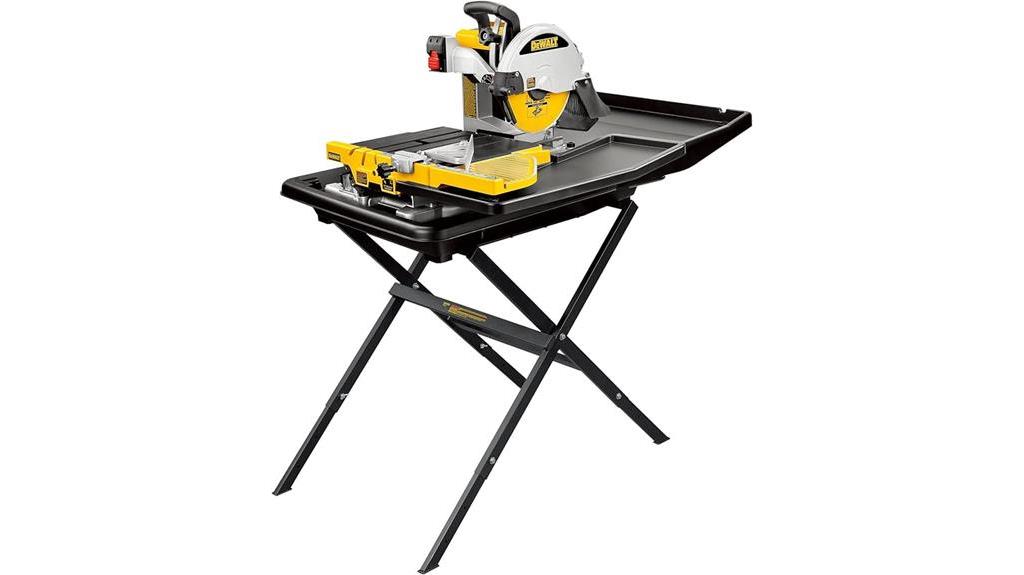
You will find the DEWALT Wet Tile Saw with Stand to be a top choice among the best wet tile saws due to its compact design and precise cutting capabilities. This saw features a 1.5 HP motor, a stainless steel rail system for accurate cuts, and a compact frame for easy transport and storage.
The included folding stand makes it convenient to transport and store, while the adjustable water nozzles ensure proper positioning of the water spray for a cleaner work area.
The DEWALT Wet Tile Saw with Stand also comes with a 3 Year Limited Warranty, providing peace of mind for your purchase.
Product Specs:
- Dimensions: 36” L x 29” W x 24” H
- Weight: 53.6 lbs
- Voltage: 120V
- Peak Horsepower: 1.5 HP
- Arbor Size: 5/8”
- Blade Diameter: 10”
- Diagonal Cut Capacity: 18” x 18”
- Max Depth Cut: 3 1/8”
- Max Rip Capacity with Plunge: 28”
- Bevel Capacity: 45ᵒ
Pros:
- Compact and easy to store
- Precise cutting capabilities
- Folding stand for convenient transport
- Adjustable water nozzles for cleaner work area
- 3 Year Limited Warranty
Cons:
- The weight may still be a bit heavy for some users
- Some users may find the price to be on the higher side
- Limited to cutting smaller tiles due to its size
SKIL 7-Inch Wet Tile Saw
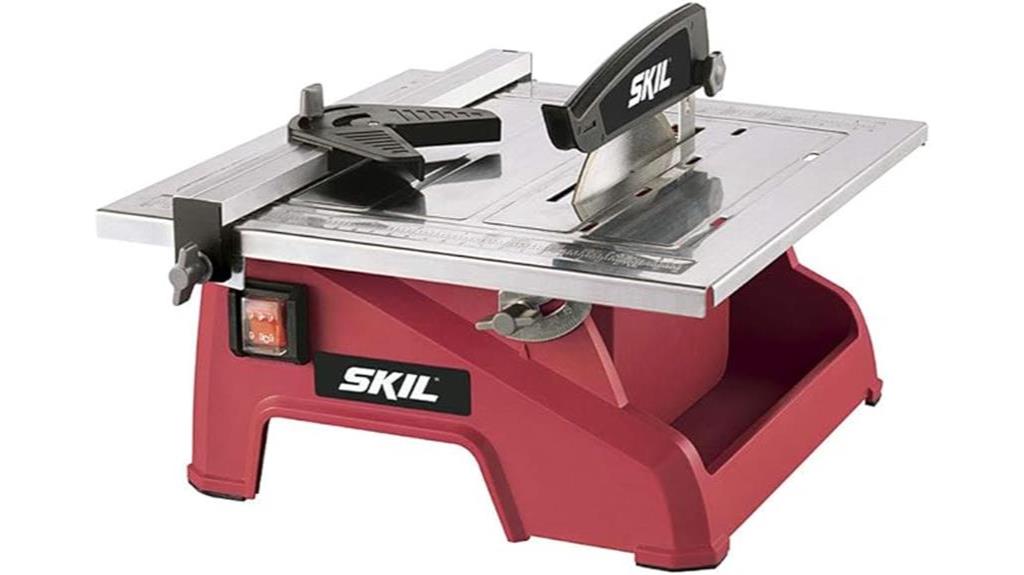
The SKIL 7-Inch Wet Tile Saw stands out as a top choice for its compact design and reliable cutting performance.
With a corrosive resistant stainless steel top that supports tiles up to 12 x 12 inches, an adjustable rip fence with miter gauge for accurate straight and miter cuts, and a blade cooling water reservoir, this saw offers versatility and precision.
It can make bevel cuts from 0 to 45 degrees and has a cross cut capacity of 7.75 inches and a diagonal cut capacity of 7.25 inches.
The saw is well put together, easy to set up, and suitable for beginners. However, it may struggle with more complex cuts and certain materials.
Overall, for basic tile cutting tasks, especially for ceramic tiles, the SKIL 7-Inch Wet Tile Saw offers good value for its price.
Product Specs:
- Corrosive resistant stainless steel top
- Adjustable rip fence with miter gauge
- Blade cooling water reservoir
- Bevel cuts from 0 to 45 degrees
- Cross cut capacity: 7.75-inch; Diagonal cut capacity: 7.25-inch
Pros:
- Inexpensive compared to more capable tile saws
- Accurate measurements and markings on the table
- Neat and easy to clean
- Small and portable
- Suitable for beginners
Cons:
- Varies in cut quality depending on the material
- Difficult to cut mosaic sheets cleanly
- Mediocre miter attachment
- Fence can be challenging to set up
- The table surface doesn’t drain well
Leegol Electric 7in. Wet Tile Saw
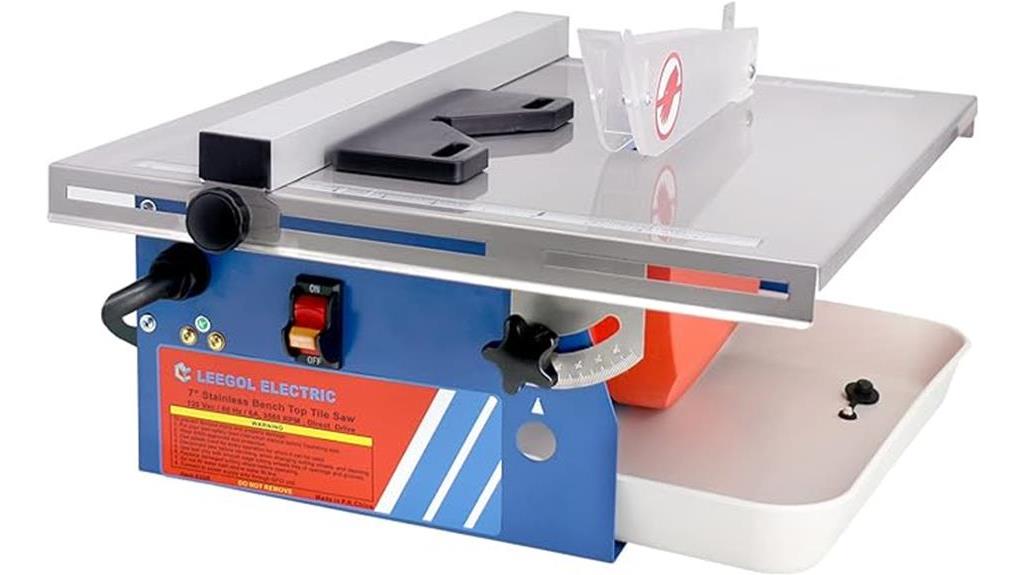
The Leegol Electric 7-inch Wet Tile Saw is known for its precision and versatility, making it a top contender in the category of best-wet tile saws.
This saw features a bevel cut capability from 0 to 45 degrees, an adjustable rip fence with a miter gauge, and a powerful induction motor with a blade cooling water reservoir. Its lightweight and fully portable design, along with the chrome-plated table to resist rust, make it an ideal tool for job sites with limited space.
The water cooling system allows for wet cutting, and its simple structure makes it easy to use and maintain. This saw is perfect for making quick, precise cuts in tile, marble, masonry, and ceramic, making it a great companion for DIY projects, crafting, and woodworking.
Product Specs:
- Bevel cuts tile from 0 to 45 degrees
- Adjustable rip fence with miter gauge
- Blade cooling water reservoir
- Powerful induction motor
- Arbor Size: 5/8
- Motor: 120V/60Hz/5A
- No Load Speed: 3550 RPM
- Blade: One more 7” Diamond Blade
- Table Tilting Range: 0-45°
- Table Size: 15-3/4” × 16-1/2”
- Max Cutting Capacity: 1” Thick, 12” Wide
- Package: 7-Inch Tile Cutter, 1 Spanner Wrench, 1 Nut Driver, 1 Instruction Manual
Pros:
- Reinforced impact-resistant tub
- Lightweight and fully portable
- Water cooling system for wet cutting
- Suitable for limited space job sites
- Powerful induction motor with thermal protector
- Simple structure, easy to use, and maintain
Cons:
- Some users experienced issues with missing parts
- Mixed opinions on the quality of the blade and measurement guide
- Difficulty in obtaining replacements for missing parts
CRAFTSMAN V20 Tile Cutter, Wet Tile Saw
Compact Sliding Cart, 7 inch, Cordless, Battery and Charger

The CRAFTSMAN V20 Tile Cutter, Wet Tile Saw, Compact Sliding Cart, 7 inch, Cordless, Battery and Charger offers a portable and convenient solution for your tile cutting needs.
With its sliding cart for improved accuracy and a 17-inch cutting capacity, this saw provides excellent water containment and a roll cage handle for easy carrying.
The 4 amp hour battery lasts for over 60 cuts, making it a reliable choice for various tiling projects. However, it lacks the ability to tilt the blade at 45 degrees for miter cuts and may present some minor unevenness in the surfaces.
Despite these drawbacks, it’s suitable for cutting porcelain tiles and rocks, making it a valuable tool for small bathroom remodel jobs.
Product Specs:
- Sliding cart for improved accuracy
- 17-inch cutting capacity
- Roll cage handle for easy carrying
- 4 amp hour battery
Pros:
- Excellent water containment
- Portable and convenient
- Suitable for cutting porcelain tiles and rocks
Cons:
- No ability to tilt the blade at 45 degrees for miter cuts
- Some minor unevenness in the surfaces
How We Review These Dewalt Pressure Washers
To provide the best wet tile saw recommendations, we conduct hands-on testing assessing power, precision, durability, and ease of use. We make various types of cuts in different materials while measuring speed, accuracy, and cut quality.
We verify the precision of adjustments and alignments. We assess water containment effectiveness. We examine the build quality of critical components.
We evaluate setup, breakdown, storage, and mobility. Noise levels and safety features are inspected. We analyze value based on performance, pricing, and cost of ownership.
Our rigorous testing provides unbiased insights into the real-world performance of wet tile saws.
To provide the best wet tile saw recommendations, our team thoroughly tests leading models from major brands.
We evaluate key criteria including:
Cutting Power
We make straight, diagonal, curved, and hole cuts in tiles of various types and thicknesses. We assess cutting speed, torque, and blade RPMs under load.
Accuracy
We verify the accuracy of angled cuts using digital protractors. We examine cut quality and chippage under magnification.
Adjustments
We rate the ease of adjusting cutting angles and depths. We test the precision of fence and miter gauge adjustments.
Water Containment
We check splash guards, water reservoirs, and drainage systems. We measure water consumption and refill frequency.
Setup/Breakdown
We time and assess the setup, breakdown, and transport process. We evaluate the storage footprint.
Build Quality
We inspect critical components like the table, cutting head, and water system for durability. We examine power transmission and vibration.
Safety
We verify blade guards and anti-kickback devices. We check for water exposure risks and GFCI protection. We measure noise levels.
Price/Value
We compare pricing to performance to determine overall value. We consider cost of ownership based on blade life and long-term durability.
Use Cases of Wet Tile Saw
Wet tile saws are used in home DIY projects and professional tile installation. Homeowners can handle small bathroom or kitchen backsplash projects with basic saws under $200.
Tile professionals need more power, larger capacities, and durability for all-day use, requiring saws from $400-$1000. Cutting stone, glass, or large format tiles demands premium diamond blades and high-torque saws.
Mosaic sheets require narrow-kerf blades to prevent chipping. Floor tiles need larger blades and depths than wall tiles. The ideal saw matches your typical tile types, sizes, project scale, and cutting needs.
Key factors that determine the best wet tile saw for your needs include:
Home DIY Projects
For basic home use, a benchtop wet saw in the $150-$300 range should suffice. Focus on usability, safety features, and cutting capacity for typical wall tile.
Professional Tile Installation
Tile pros need more power, larger capacity, and worksite portability. Quality stand tile saws from $400-$1000 are ideal for contractors. Durability and precision are vital.
Glass, Stone, and Ceramic Cutting
Cutting dense materials like stone requires premium diamond blades and high torque saws with 10-15 amp motors. Extended tables aid stability and control.
Mosaic Tiles
Mosaic sheets can be tricky. Look for saws with narrower blade kerf to reduce tile chipping. Adjustable water nozzles help contain overspray.
Floor Tile vs. Wall Tile
Floor tile is thicker than wall tile. Ensure your saw can handle the depth via blade size, adjustments, and power. Larger tables provide support.
Benefits of Wet Tile Saws
Wet tile saws are an essential tool for any tile installation project. They use a diamond-tipped blade and water to cool and lubricate the blade while cutting, allowing for smooth, clean cuts through ceramic, porcelain, stone, and glass tiles.
The water prevents overheating and also minimizes dangerous dust. Wet tile saws are extremely accurate, making precise straight or angled cuts. They have adjustable fences to ensure consistency.
Compared to manual tile cutters, they are faster, require less physical exertion, and can handle thicker tiles. Wet tile saws are available in different sizes from small portable models to larger contractor models.
They save significant time and effort on large tile jobs. With the right blade, wet tile saws can cut any tile material cleanly and accurately.
Compared to manual tile cutters or dry saws, wet tile saws provide:
- Cleaner Cuts – Water cools blades and flushes away debris
- Reduced Dust – Water minimizes airborne tile particles
- Blade Longevity – Water lubricates and prevents overheating
- Versatility – Make various types of cuts in multiple materials
- Precision – Accuracy within 1/32″ for professional results
- Safety – Built-in water containment and blade guards
For most tile projects, a quality wet saw is an essential time-saving tool. Renting or buying the right saw for the job will lead to professional looking results.
Safety Tips for Using Wet Tile Saws
When operating a wet tile saw, safety should always come first. Wear eye protection like safety glasses and a face shield to prevent debris from hitting your eyes.
Wear a dust mask to avoid inhaling particulate. Use cut-resistant gloves to protect your hands, as the blade is extremely sharp. Keep hands away from the blade path and never reach into the blade area.
Allow the blade to reach full speed before starting cuts and do not force tiles through too quickly. Ensure adequate water flow over the blade during operation. Avoid loose clothing that could get caught in moving parts.
Unplug the saw when changing blades or making adjustments. Clean up spills immediately to prevent slips. Always unplug the saw and allow the blade to fully stop before handling cut tiles or making adjustments. Following proper safety procedures is critical when operating this powerful saw.
To safely operate wet tile saws:
- Wear eye protection – safety glasses or a face shield
- Use the blade guard and anti-kickback devices
- Unplug saw before changing blades
- Properly secure tile to avoid movement while cutting
- Ensure good workspace lighting to see clearly
- Avoid water exposure risks – keep electrical components dry
- For gas models, ensure adequate ventilation
- Maintain proper footing and do not overreach to avoid slips
- Allow saw blade to reach full speed before starting cut
Following the manufacturer’s instructions and basic safety practices will allow you to harness the cutting power of a wet tile saw without risks.
Maintenance Tips
Regular maintenance helps wet tile saws operate safely and efficiently. Always unplug before any maintenance. Check and top off the water level before use.
Empty and clean the reservoir periodically to remove accumulated slurry and debris. Wipe down the table to keep it free of debris. Frequently inspect the blade for chips, wear, or damage and replace it when needed.
Lubricate slide components periodically. Check that the blade guard operates properly and make any needed adjustments. Inspect water nozzles and hoses for clogs or damage.
Clean slurry and debris off the blade with a putty knife or brush; avoid wire brushes. Apply blade wax occasionally for lubrication.
Check that moving parts are properly aligned and adjusted. Store the saw protected from the elements when not in use. Proper maintenance helps ensure smooth operation, prevents overheating and prolongs the saw’s lifespan.
To maximize your wet tile saw’s lifespan:
- Frequently change water to limit debris buildup
- Regularly inspect blade for wear, damage, or dulling
- Lubricate slide rods and rail mechanisms as needed
- Verify alignment of cutting head and adjust as needed
- Check water nozzle adjustment and flow
- Clean table surface and miter gauge slots
- Inspect the power cord and GFCI functionality
- Drain water and wipe down after use to prevent rust
Proper wet tile saw maintenance reduces wear on components, prevents costly repairs, and ensures smooth accurate cuts.
Latest Trends in Wet Tile Saws
Some of the latest trends in wet tile saw technology focus on improved precision, faster cutting and added versatility. Higher precision fence systems allow extremely straight, accurate cuts. Quick clamps speed up aligning and securing tiles.
Larger motor sizes enable faster blade speeds to cut tiles smoothly and quickly. Extended cutting lengths accommodate larger format tiles.
Bevel cutting capabilities allow angled cuts for mitered edges. Plunge cutting features provide stopped cuts for outlets or fixtures. Sliding tables provide extra cross-cutting capacity and control. Low-splash guards contain overspray.
Laser guides add cutting accuracy. Larger water reservoirs and detachable pans simplify maintenance. As tiles get larger and harder, wet saws continue improving with more powerful motors, sturdier construction, and convenient features.
Some recent advances in wet tile saw technology include:
- Larger cutting capacities for bigger tiles and thicker materials
- Improved portability with lighter materials and better balancing
- Enhanced dust containment systems using downdraft water flow
- Laser guides for better precision and line-of-cut visibility
- Digital displays for cut dimensions and angled measurements
- Quick clamping systems for faster tile securing
- Extended rip fences and miter gauges for longer cuts
- Upgraded motors and gearing for increased power
- Ergonomic enhancements like slide tables and overhead saws
FAQs
Q: Can I use a wet saw indoors?
A: Benchtop wet saws are fine for indoor use if proper precautions are taken to contain water splashing and drain wastewater. Ensure electrical components are protected. Never use gas-powered saws indoors due to toxic exhaust.
Q: How often do tile saw blades need to be replaced?
A: With proper use, quality diamond wet saw blades can last 50 hours or more before needing replacement. Inspect blades regularly for wear, chips, or dulling. Replace damaged blades immediately for safety.
Q: What size tile can my saw handle?
A: The maximum tile size depends on the saw table dimensions, blade size, motor power, and depth of cut. Always choose a saw that exceeds the largest tiles for your project to allow room for maneuvering.
Q: Can I cut stone or glass with a wet saw?
A: Yes, provided you use the proper diamond-impregnated blade designed for cutting that material. The saw must also have sufficient power and adjustments to handle the thickness.
Q: How precise can wet saw cuts be?
A: With precision fences, miter gauges, and adjustable tables, the best wet saws can achieve cuts within 1/32″ for professional quality results.
Key Facts
Wet tile saws are specialty power saws designed specifically for cutting tile materials like ceramic, porcelain, and stone. They use a diamond-tipped blade and water to lubricate and cool the blade and tile during cutting.
The water prevents overheating and makes clean, smooth cuts while minimizing dangerous dust. Wet tile saws are extremely accurate and can make straight, mitered, or curved cuts.
They are available as benchtop or stand models, ranging from small portable saws to large contractor saws. Wet tile saws are faster, more versatile, and handle thicker tiles compared to manual tile cutters. They are an indispensable tool for any large tile installation job.
- Wet tile saws use water to cool blades and reduce dust during cutting
- The main types are benchtops, stands, sliding tables, and overhead saws
- Key features are blade size, motor power, water system, adjustments
- Prices range from under $100 for basic DIY saws to over $1000 for heavy-duty models
- Professional saws offer larger rip capacities, power, precision, and durability
- Proper use of blade guards, GFCI, and containment systems is vital for safety
- Regular cleaning and maintenance will maximize the lifespan of a wet tile saw
A quality wet tile saw is an essential investment for perfectly cutting tile materials. This buying guide provides the information needed to select the right wet tile saw for home or professional use.